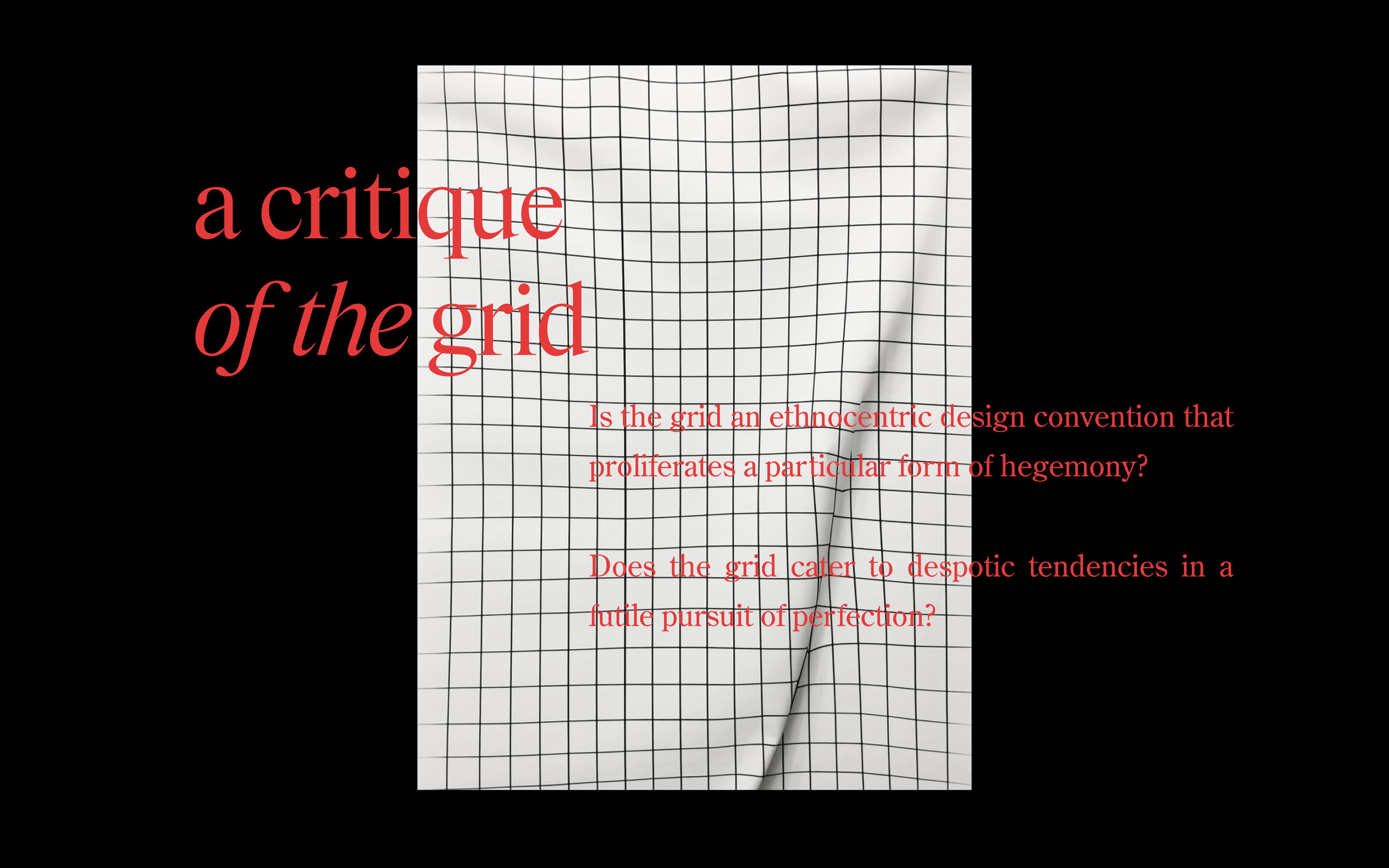
The visual convention of the grid provides a framework for order, but it often separates agency from the audience and imposes an absolute way of seeing. The grid is often treated as neutral, rational, and inevitable. It is none of these things.
A more contemporary, post-colonial, and pluralistic aesthetic approach might not use grids at all. Insistence on the use of and alignment to grids, particularly without discourse around their origins or legitimacy, often reveals the absolute and totalizing qualities of the underlying dogma associated with modernist design systems. This observation is less a judgment of individuals than a reflection of the systems they choose to enforce, despite those systems’ inherent limitations and the narrow practices they perpetuate.
Exploring alternatives to hegemonic conventions such as the grid, particularly those overlooked by the imposition of certain aesthetic values, can reveal a rich tapestry of unique possibilities for experience.
There is something aesthetically regressive and perhaps inhumane about designing products that prioritize the preferences of Western audiences while imposing only that aesthetic on the rest of the world.
What the grid erases
It erases situated perception.
The grid presumes a stable, frontal viewer with a fixed distance from the object. It privileges seeing over sensing and assumes vision to be neutral and universal. In doing so, it flattens context, environment, and relation, treating experience as something to be scanned rather than inhabited.
It erases cultural specificity.
By presenting itself as neutral, the grid obscures its uses in modernism, industrial rationality, and colonial systems of measurement and control. Local spatial logics, ornamental traditions, oral cultures, and non-rectilinear forms of organization are often dismissed as decorative, inefficient, or unscalable.
It erases agency.
When alignment becomes obedience, participation becomes passive. The grid tells the audience where to look, how to move, and what matters. Choice is constrained not by necessity, but by convention.
What alternatives are not
Alternatives to the grid are often misunderstood as chaos or excessive aesthetic indulgence. This is a convenient mischaracterization.
They are not anti-order. They are not anti-clarity. They are not a rejection of structure.
They are a rejection of universalized structure imposed without consent or context.
What alternatives could be
A pluralistic approach does not replace one dominant system with another. It allows form to emerge from circumstance.
Adaptive structures
Layouts that respond to environment, scale, culture, and use, rather than enforcing consistency for its own sake. Structure as something discovered, not imposed.
Temporal design
Interfaces and artifacts that change with time, use, season, or relationship. Meaning that accumulates rather than snaps to a grid.
Embodied interaction
Design that accounts for movement, touch, proximity, fatigue, and sensation. Not everything needs to be reducible to a rectangle.
Relational composition
Elements defined by their relationship to one another rather than their alignment to an invisible lattice. Proximity, tension, overlap, and flow as organizing principles.
Pluralistic aesthetics
Acceptance that different cultures, communities, and contexts may require fundamentally different visual logics, and that coherence does not require uniformity.